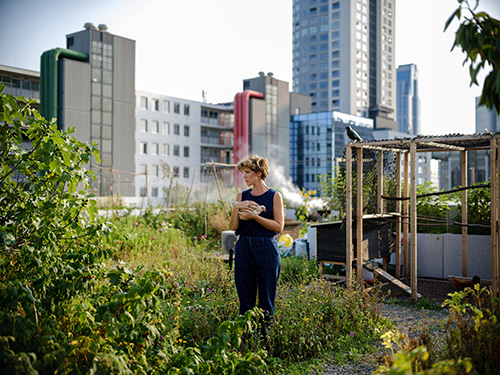
Bryce, a chef this fascinating must have a fascinating origin story?
Well, I was born in Lelystad, a small town thirty-minutes or so out of Amsterdam. Before I was a chef, I studied Sports Education, and my side-job was as a dishwasher in a restaurant. I was 16 and, from that point on, I fell in love with that world. Not particularly cooking, but just the life in the kitchen. It was the first time I felt that I didn’t have to hide my true personality. So I switched schools and started studying to become a chef. It was only years later that I realised I’d actually been dishwashing in quite a good restaurant.
Where did your experimental streak come from?
I always had trouble with authority. In a kitchen, they give you the recipe, and you have to make it like that. After six months of doing it the same way, I would always find new techniques to do it differently, or better. And the chefs would say, “ Just follow the recipe.” I pushed back, kept finding other ways. But that experimentation didn’t develop into this plant-forward, circularity approach until 2-3 years ago, when I started at Veronicaschip.
So how did you go from finishing chef school to becoming founding chef of your first restaurant?
Hard work. [Laughs] During chef school, I worked in high-end restaurants, I was competitive. I said to myself, “Okay, I want to be head chef before 30. And I want to have my own restaurant when I’m 35.” That was my goal, but it ended up going even better than I had planned. When I was 22, just one year out of chef school, I got my first sous-chef job at Bar Italia. When I was 23, I became sous-chef of a really high-end restaurant (Restaurant Vandemarkt) under Jean-Joel Bonsens, former chef of Christophe*, who really trained me. After that, because of the first financial crisis, in 2013, I went freelance and was assisting workshops at de Librije***, a three Michelin-star restaurant in Zwolle. There I was introduced to my first founding chef position, for Pesca – it was a fish concept, and a big success.
As someone who has a problem with authority, how did you excel so fast in these kitchens – which are authority-heavy environments?
I always wanted to control things for myself, that was my authority-issue. So I thought, “Okay, if I want to keep doing this job and I want to have fun, then that means that I need something of my own.” And so I shut up and set to work at being better than even the head-chef. If the kitchen started at 11, I was there at 9:30, just to make sure that I reserved the best products and had the best equipment for the day. I would do some chores for the chef, so that when he came in and asked, “Who cut my herbs?”, I’d say “I did, chef.” And because I got in early, by the afternoon I was freed up to help out with something else. This is the way you make really big steps in the kitchen, because you’re provoking authority, but in a positive way. This helped me.

Anybody you really butted heads with?
Yes. Rick van der Meer of Prinses Juliana (Valkenburg) and Spring (Amsterdam). He was the most horrible chef I ever worked under. We didn’t really see eye-to-eye. I was in my second year of chef school when I came through his kitchen, along with five other students. Just to give you an idea of the atmosphere in this restaurant, the front of the house made bets every year on who would make it until Christmas. Rick gave me so much shit, but I kept on cooking, showing up early. I was the only student who made it through Christmas. But in April, I broke just like the rest and called my mom crying…
Where are we right now? Tell me about Atelier Thuisbasis.
The idea came from a pop-up that I did last year to explore whether circular gastronomy really works or not. I wanted to see if there were business opportunities in working with waste-food products. I realized pretty immediately how much there was to develop in this area. My father said, “It looks like you should have your own laboratory.” And that stuck in my head. That was exactly what I needed: freedom and a space for people to taste and understand what I’m working on. I can make ten recipes out of one banana peel. But which one will people like the most? I needed to test. So we found this building in December, last year. And then in March, when we were set to run, the COVID-19 crisis started.
How did Atelier Thuisbasis cope with lockdown then?
Well, we had a delay until the restaurants were allowed to open again. But it gave me the opportunity to fund an initiative called Sorgbasis, under the command of my dear friend Lidwien Groeneveldthat, that saves the food from the closed-down restaurants and gives it to the poor and homeless in Amsterdam. When that food ran out, we started working with supermarkets’ waste-food. We are able to get meals to 150 – 200 people.
How do the workshops and tastings at Atelier Thuisbasis generally go?
We generally serve 35 people in one go for a sit-down dinner. If everybody stands, we can go up to 60-65. The events always revolve around circularity. I only use products that come from overproduction. I work a lot with Instock, an organisation that buys waste from supermarkets and distributes it to restaurants or shelters. That means my list of products changes every day, and from this list I create a five-course menu. I try to use everything, even the burnt ashes from the grill, to show people that circularity is something you can put into practice in your own home, restaurant, office… That’s what I talk about, and every dish comes with a small story of its circular development, its ingredients, the philosophy behind it. Then we eat it and get some feedback.
Supermarkets aren’t so good on “seasonal ingredients”. How do the seasons play into your menus when you’re sourcing from these places?
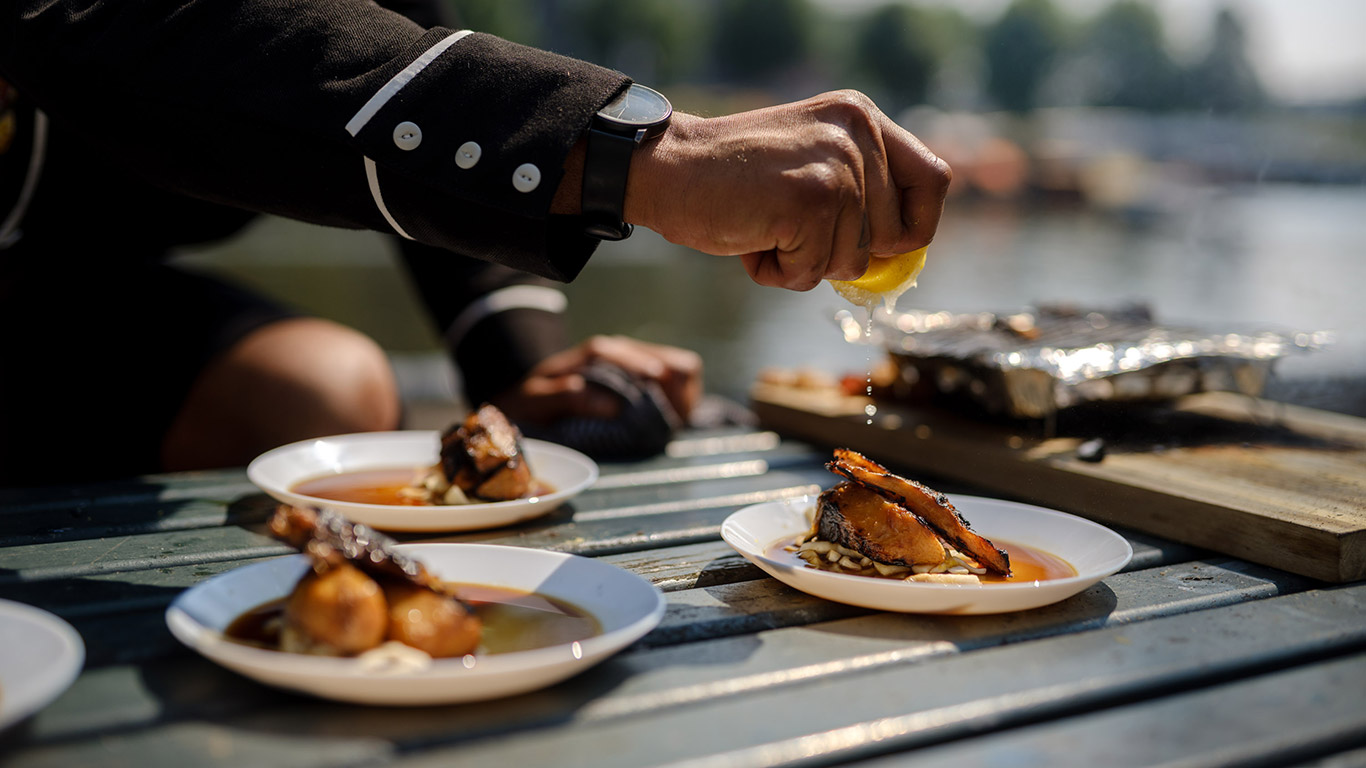
I always try, but it isn’t always easy. Right now, though, I’ve got a lot of plums. I’m making a kombucha and a lacto-fermentation from them – this one is an eleven-day process which changes the structure and flavor of the plums. When this is done, I can use it to make cider, or take the waste and caramelize it, or dehydrate it. I’ll bake a little fish, make a plum-compote, or a sauce from the kombucha, and put the two together. Then I’ll try to deconstruct the fish for another dish. I can process 95% of a whole cod. I can dehydrate the skin, or make a really nice crème from the eyes.
I want to say “that sounds tasty”, but…
[Laughs] Exactly! But that’s the whole reason why I started to focus on waste circularity in my food. The inevitable waste, the stuff you think you have to throw away, like banana peels, the head of the cod, is actually edible. Not just edible, but incredibly complex and deep in flavor. I want to show people that we’re really spoiled when we go to the supermarket and buy prepackaged fillets, the best cuts. The “shitty parts” go to waste, we don’t even see them – why? My main goal is to inspire and give people a different kind of mindset.
Do you think it’s working?
We still have a long way to go before people really understand circularity, but we are getting there. I’m not going to tell you that you have to cook another way or use different ingredients. But if I show you that if you buy something, that you can use more than you know; that if you look differently at your product, it will actually help you out, then that’s great. I want people to ask: “Why? Why am I using this product? Why am I using this part and not that part? Why am I throwing this away?” If you ask yourself the question why, you realise most of the time you don’t know. Why? Why? Why?
Okay, Bryce, so “why” did you make a dinner out of human blood?
Oh, you read about that, huh? [Laughs] So the mysterious Gwen van der Zwan posted something on Instagram about needing a chef who’d be happy to work with human blood. We got in contact, but I said right away, “I’m not going to be your guy, but I’m curious.” I went by Vice, where she worked, and, after a brief chat, I was like: “Okay, let’s go, fuck it”. And, together with Krisztina Czika and Mediamatic, we developed this insane dinner. But why did I do it? One: it was really interesting to develop. Two: the freedom that I have is limited in the city nowadays. Amsterdam used to be so non-judgemental – you could do anything you felt like doing. When I told my friends and family about the idea, they said, “Oh, typical Bryce.” But they also said that I should be careful, because the newspapers and people on social media were going to say bad things about it. But that was exactly why I had to do it. Why should I be afraid of people who can’t even tell me to my face what they think of my projects? Once I decided that, then we just had a crazy load of fun.


Where did you source your “ingredients”?
We got everybody to donate their blood, because otherwise it just becomes cannibalism. [Laughs] We actually did a lot of research before, what’s possible and what’s not, health-wise, legality-wise. In the end, I devised a six-course menu, and every course had something human inside. So we had a dish of onion smoked in human hair, we had a dish salted with tears, we had three dishes with human blood, including one with white asparagus which was visually incredible. A white plate with one white asparagus cooked in a clear broth, and then you drip your own blood over it. The way it looked over the dish, and how the blood pooled into these crazy shapes in the broth… Some people fainted. It was quite hectic. [Laughs]
Were you one of those people?
No, no, no. I had to give a lot of blood, actually, to be sure the dishes worked. And for the tears, we had to smear onion under people’s eyes – so that was intense. The tears dropped on to this edible paper, and then we’d use that to salt a dish. And the dish with the human hair: we collected hair from everybody who wanted to give it, then smoked onions in it to get this really distinctive flavor.
That’s a very different take on circularity.
[Laughs] Yeah, we kill millions of animals every day for our eating habits. But if I ask for a little bit of your hair so I can eat it, you think that’s weird? From this vision, we developed this insane dinner.
Obviously, Green is Golden is a plant-based concept. What do you want people to learn with regards to meat-eating and how they approach plant-based food nowadays?
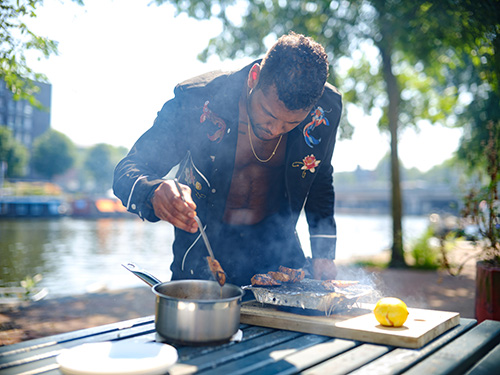
That eating a plant-based diet doesn’t have to be boring. And if we want to keep the world going much longer, we should change our diet. Here’s the thing: I’m not 100% supportive of a fully-vegan diet. I’m more of a flexitarian, but, to me, the most important thing is consuming with a conscious mind. And that means following a plant-forward diet. And that’s why Green is Golden hit me with the barbecue vibes, because, for me, that was one of the hardest to make interesting for plant-forward diets. If I go to a barbecue, the first thing I’m going to buy is meat, because it’s easy, it’s pre-packaged, mass produced, five euros for ten boxes… But one of the reasons that Thuisbasis is a success is that we show that you can have vegetables looking like fish, looking like meat, if you have the right recipes. And I think if you show people visually, it helps more than just telling them.
So where next for Atelier Thuisbasis?
We had an idea a couple of weeks ago to start a brewery with our in-house fermentation specialists. A circular brewery, actually. And we want to do a yard sale of all the compots, ciders, kombuchas we make, which will go to waste with the second lockdown imminent. If that’s a success, the brewery will get the green light.